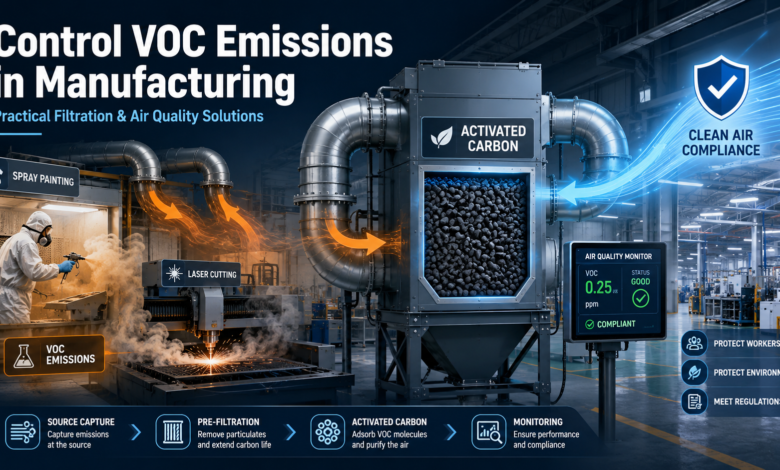
Volatile Organic Compounds VOCs are an unavoidable byproduct of many manufacturing processes. Spray painting, coating, resin application, laser cutting, printing, and adhesive bonding all release organic vapors into the air. Left unmanaged, these emissions create health risks for workers, contribute to outdoor air pollution, and put businesses at risk of regulatory penalties.
The good news is that VOC control is well understood and achievable with the right filtration approach. This guide covers what VOCs actually are, where they come from in industrial settings, why they matter, and what you can realistically do to keep emissions under control.
What Are VOCs and Why Do They Matter?
VOCs are carbon-based chemicals that evaporate easily at room temperature. In manufacturing environments, the most common ones include toluene, xylene, benzene, MEK (methyl ethyl ketone), formaldehyde, and various chlorinated solvents. They’re found in paints, varnishes, adhesives, cleaning agents, and the byproducts of thermal cutting processes.
Short-term exposure causes headaches, dizziness, and eye or respiratory irritation. Long-term or high-level exposure to certain VOCs — benzene in particular — is linked to more serious health outcomes including liver and kidney damage and increased cancer risk. From a regulatory standpoint, most countries have strict limits on VOC emissions to atmosphere, with Italy’s D.Lgs. 152/2006 being one of the more comprehensive frameworks in Europe.
Common Sources of VOC Emissions in Industry
VOCs show up across a surprisingly wide range of production processes:
- Spray booths and paint lines: solvents in liquid paints and primers are a major source
- Printing and lithography: solvent-based inks release VOCs during application and drying
- Resin and adhesive processes: bonding agents in furniture, composite materials, and packaging
- Laser cutting of plastics and organic materials: thermal decomposition releases benzene and other compounds
- Surface treatment and degreasing: chlorinated solvents are widely used but heavily regulated
- Wood processing and coating: lacquers and stains applied to furniture or flooring
Understanding where your VOC load is coming from is the first step. A site survey or air quality assessment can quantify emission points and help prioritize where filtration effort is most needed.
See also: Seize Easy-to-Sell Goldmines in the Explosive Trade Business
Why Standard Filters Don’t Cut It
Particulate filters — the kind used for dust and fumes — are not effective against VOCs. VOC molecules are simply too small to be captured by mechanical filtration. They pass straight through even high-grade HEPA filters unchanged. This is a common mistake in system design: assuming that a good dust extraction setup also handles chemical vapors. It doesn’t.
VOC control requires adsorption — a chemical process where molecules are attracted to and held on the surface of a porous material. And the most effective and cost-efficient material for industrial adsorption is activated carbon.
Activated Carbon: The Right Tool for VOC Control
Activated carbon works through an enormous internal surface area — a single gram can have over 800 square metres of surface. VOC molecules passing through an activated carbon bed are drawn to this surface and held there, effectively scrubbed from the airstream. The process requires no energy input beyond moving air through the filter bed, which makes it both reliable and economical to run.
For industrial applications, activated carbon is typically used in pellet or granular form. A practical option used across spray booths, kitchen extraction systems, and VOC abatement installations is Carbone Attivo, activated carbon supplied in 25kg bags as 4mm cylindrical pellets. With a specific surface area of 850 m²/g and a CCl₄ adsorption rate of 45%, it meets the performance demands of professional filtration systems and is suitable for recharging activated carbon purifiers of any brand.
Carbon filters do have a finite capacity — once the carbon is saturated, it stops adsorbing and needs to be replaced. Replacement frequency depends on the VOC concentration in the airstream and the volume of air processed. In high-load environments like busy spray booths, this could be every few months. In lighter applications it may be annually. Either way, keeping track of filter age and running regular checks on outlet air quality is essential.
Designing an Effective VOC Control System
A properly designed VOC abatement system combines several elements working together:
- Source capture: extract contaminated air as close to the emission point as possible, before it disperses
- Pre-filtration: remove particulates (paint overspray, dust) upstream of the carbon bed to prevent premature loading
- Activated carbon stage: sized to the expected VOC load and required contact time for effective adsorption
- Monitoring: outlet air sampling or differential pressure monitoring to track filter saturation
One important sizing note: activated carbon beds need sufficient depth and dwell time to work properly. Thin carbon layers with high airflow velocity will allow VOCs to break through before adequate adsorption occurs. This is where working with a specialist rather than buying off-the-shelf pays off.
Getting It Right From the Start
VOC control isn’t something to retrofit as an afterthought. Getting the extraction, pre-filtration, and activated carbon stages properly sized from the outset saves money, avoids compliance headaches, and protects the people working in your facility every day.
If you’re assessing VOC control options for a spray booth, coating line, or any other emission-intensive process, Airmec specialises in industrial air treatment systems — from initial site assessment and system design through to supply, installation, and ongoing maintenance. With decades of experience across manufacturing, automotive, food processing, and pharmaceutical environments, they can help you build a VOC control setup that meets regulatory requirements and actually works in practice.