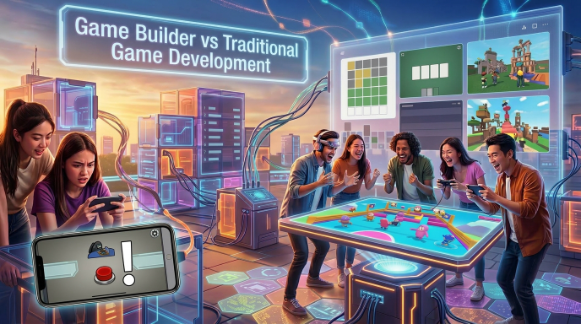
Most of us have had an amazing video game idea at one point or another, only to be met with a brick wall when trying to figure out how to actually make it. You have to learn complicated programming languages, you need to navigate through complex engine interfaces, and then you spend all your time debugging code instead of, you know, being a creative person. It’s really demoralizing you when all you want to do is make your fun little concept take shape and not take a full course in computer science.
And that’s why opting for an easy-to-use game builder on Astrocade for your game development needs rather than the traditional development method is becoming the way to go for most developers. In this clash, we’ll pit the drag-and-drop mechanics, rapid prototyping pace, and friendly creation suites against the coding workflows of the past. You are going to be surprised how easy it is to get your own, very own playable title out there without writing a single line of script.
No Code Needed with a Modern Game Builder
Old-school game development involves writing thousands of lines of complex code, managing datasets, and building layered physics engines from the ground up. Miss a single semicolon, misplace a variable, and your entire project can break on you, sending you into hours of troubleshooting. The very high technical barrier means that eager designers often spend more time fighting software bugs than building imaginative worlds.
Modern visual engines change the entire dynamic, going from hand-writing lines of code to putting together logic using intuitive drag-and-drop blocks of code, as well as visual scripting tools. You can configure the movements of characters, the winning conditions, and triggers of hazards by using simple drop-down commands. It lets inventive creators concentrate all of their energy on building compelling mechanics and unforgettable visual grids and layouts.
Build Games Faster
It’s not unheard of for you to make a full-length video game with traditional studio production pipelines, and previews of builds take months or years. You have to write custom scripts for character controllers, manage asset pipelines, and build UI systems from scratch. This glacial velocity makes it hard to test if your initial concept is actually fun to play before spending massive amounts of time.
A web-based creation suite shrinks that lengthy timeline from several months to a few hours. You get pre-packaged physics, responsive character templates, and plug-and-play asset libraries, all right out of the box. Whether you’re building a simple platformer or a fast-paced game, you can take a rough idea and make it real in a single afternoon.
Instant Player Testing
Collecting early player feedback with traditional development involves building separate builds for each platform, uploading files to external servers, then emailing playtesters massive download links. This awkward distribution channel drags out the iteration process and discourages more casual players from giving off-the-cuff feedback. You’re waiting days, maybe weeks, just to find out if a level design is too hard or too confusing.
Browser-based development tools remove distribution friction by enabling you to publish instant web links with one click. Everyone can play your latest build right in their regular web browsers, no downloading executable files or installing packages. Getting live feedback from real players on the live game allows you to modify level design and tune mechanics in real time.
Low Cost Entry
Starting a typical game studio, after all, often involves buying a bunch of powerful computers, several expensive software licenses, and renting dedicated server space to store all those development files. These massive financial obligations make it difficult for hobbyists, students, and indie developers to actually make their concepts playable. With no massive upfront investment, lots of wonderful ideas never take flight.
Visual creation suites democratize the entire design process, being native in the form of lightweight web browsers with zero upfront cost. You have professional-level editors, built-in asset bundles, and multiplayer cloud hosting all at no cost. It eliminates the financial risk, allowing everyone equal access to state-of-the-art game creation tools, no matter how big their wallet.
Easy Shared Play
Sharing a game you’ve coded traditionally with your friends or online community involves navigating a maze of storefront submissions, platform approvals, and hardware compatibility checks. If a friend uses a different operating system or is low on disk space, they may not be able to play your game at all. Such technical hurdles kill the fun of showing off your shiny new creation to the world.
Next-gen creation hubs simplify sharing to just pasting a direct room link into a group chat. Your audience can instantly warp into your custom levels, compete on live leaderboards, and try out your new mechanics alongside one another. Getting your creative projects out to real players instantly with no hardware limitations is possible by publishing on accessible platforms like Astrocade.
Conclusion
The choice between visual creation suites and traditional game development rests on your goals as a developer, technical experience, and the scope of your project. Traditional coding techniques allow for infinite customization and are capable of supporting projects of vast commercial scale, but they require months of arduous technical training and substantial financial investment. Visual web engines eliminate those barriers, enabling you to shape raw ideas into fully playable games in hours rather than years.
Visual creation systems also provide the fastest route to making your dream a reality, whether that’s experimenting with visual scripting, creating custom levels for your friends, or developing a frenetic game like Minecraft Skyblock. Get on to easy web platforms like Astrocade now , begin creating your first project with no need to code, and publish your games to the world straightaway in your browser.
See also: Understanding Rehab in India: What Families Should Know Before Choosing a Treatment Centre
Frequently Asked Questions (FAQs)
Do I need any coding knowledge to use a modern game builder?
No. Today’s visual development systems employ familiar drag-and-drop blocks, predefined logic rules and visual scripts that make it possible for anyone to create working games without having to write traditional code.
Is a visual creation tool powerful enough to make multiplayer games?
So the best web platforms have their own networking engines that manage multiplayer lobbies, player sync, room links, etc. are taken care of automatically, without the need to write any complex network code.
What is the biggest advantage of traditional game development over visual engines?
In contrast, classic coding allows full access to low-level engine structure, hardware memory management, and custom graphics pipelines necessary for large scale 3D console or PC games.
Can I play and test my creations on mobile devices?
Yes, creation engines that run in the browser do use responsive HTML5 technology, so your published games are automatically adapted for smooth touch controls on mobile phones and tablets.
How fast can I publish and share my first game?
You can create for free and publish a straightforward playable game in under an hour, with an instant web version link that anyone can tap and play from their phone.