There is nothing worse than a fitted sheet that pops off at 2 a.m. You pull it back but it pops off again. By morning, you are sleeping on a bare mattress. If this sounds familiar, the problem probably is not the sheet itself. It is the fit.
King beds are not all the same size. Mattress depths vary quite a bit, and most people do not realize this until they are already frustrated. That is where deep pocket king sheets come in. But buying them without knowing what to look for is just trading one problem for another.
Here is what you need to know before you buy them.
What “Deep Pocket” Actually Means
A standard fitted sheet is designed for mattresses up to about 12 inches deep. Anything beyond that, and the sheet will struggle to stay on. Deep pocket king sheets are cut to fit mattresses between 13 and 17 inches. Some are labeled extra deep pockets, which can accommodate mattresses up to 22 inches or more.
The numbers matter. A sheet labeled “deep pocket” without a specific measurement is vague. Always check the listed pocket depth, not just the label.
Why King Mattress Depth Varies So Much
Most people assume a king mattress is just a king mattress. It is not that simple.
Here is why depths differ:
- Standard innerspring mattresses typically run 8 to 12 inches.
- Pillo -top mattresses add 2 to 4 inches on top of the base.
- Memory foam mattresses often measure 10 to 14 inches.
- Hybrid mattresses can reach 14 to 16 inches.
- Mattress toppers add another 2 to 4 inches on top of whatever you already have.
If you sleep on a hybrid with a topper, you could easily be at 18 to 20 inches total. A standard sheet will not come close to fitting that. Measure your mattress before you shop. It takes 30 seconds and saves a lot of frustration.
The Problem With Sheets That Do Not Fit
A sheet that is too shallow will pull tight, pop off corners, and bunch under you while you sleep. You will feel it. Your sleep suffers.
A sheet that is too deep will gather and bunch, creating uneven surfaces that feel uncomfortable through the night. It might stay on, but it will not feel right.
Neither situation is acceptable when you are spending real money on quality bedding. The fit has to be correct for the sheet to perform the way it should.
How to Find the Right Fit for Your King Bed
Step 1: Measure your total mattress depth.
Use a tape measure. Go from the top surface down to the base. If you use a topper, include that in the measurement.
Step 2: Add 1 to 2 inches for comfort.
You want the sheet to wrap fully around the mattress without pulling. A little extra depth is better than not enough.
Step 3: Check the labeled pocket depth on the sheet.
Do not go by general terms. Look for the actual inch measurement. A sheet listed as fitting mattresses “up to 18 inches” is useful. “Deep pocket” alone is not enough information.
Step 4: Look at the elastic.
Full perimeter elastic holds the sheet in place far better than corner-only elastic. On a king bed, this difference is significant. The sheet has more surface area to cover and requires more grip to stay in place.
See also: Can I Stay in My Home During a Bathroom Renovation?
Material Matters Too
Fit is the first consideration, but fabric also plays a role in how well the sheet holds up over time.
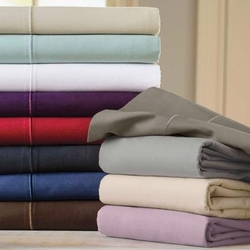
Egyptian cotton is one of the best bets for a deep pocket king sheet. The long staple fibers hold their shape through repeated washing. The fabric softens with use rather than wearing thin. Thread counts between 300 and 600 tend to offer the best balance of softness and durability, according to the American Textile Manufacturers Institute.
Percale weave gives a crisp, cool feel. Good for warmer sleepers or hot climates.
Sateen weave has a smoother, slightly heavier feel. Better for cooler months or people who prefer a softer surface.
Both weave types are available in deep pocket cuts. The right choice depends on how you sleep and what feels comfortable to you.
A Note on Thread Count
Thread count is not the only measure of quality, and higher is not always better. Sheets above 800 thread count are often made with thinner, multi-ply threads that trap heat and feel dense. A well made 400 thread count Egyptian cotton sheet will outperform a 1000 thread count sheet made from lower grade fibers most of the time.
Look at the material and construction first. Thread count is one part of the picture, not the whole story.
When You Are Still Not Sure Which Depth to Choose
If you have measured your mattress and you are still unsure, go one size up. A sheet with slightly more pocket depth than you need will always outperform one that is too shallow.
Getting the fit right is the single most useful thing you can do to improve how your bedding performs. The fabric, the weave, the thread count — none of it matters much if the sheet does not stay on the bed.